
⏱️
Validated at Compile Time
APT catches violations before your app runs. Missing @QfCrypto? Skip a privilege declaration? Build fails. Not a warning — an error.
Define intent once. APT enforces it at compile time. Runtime enforces it everywhere else. Less code is a side effect — correctness is the goal.
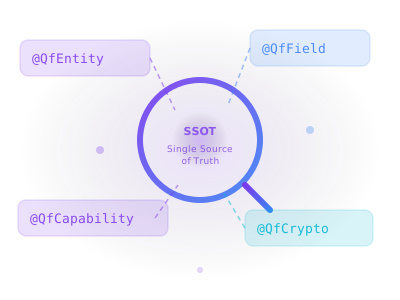
@QfEntity
class Employee {

    @QfCrypto
    String salary;

    @QfCrypto
    String phone;
}DB: salary, phone → stored encrypted automatically
API: salary, phone → decrypted automatically on read
UI: salary, phone → shown only to authorized roles
If @QfCrypto is missing → compile errorNo extra service. No extra config. The annotation is the contract — the system enforces it.
@QfEntity(capabilityKey = "employee-management")
class Employee {
    @QfCrypto
    String salary;
}
Annotations are the machine-readable spec. Not documentation. Not convention. A contract.
javac + q-apt (Annotation Processor)
  → reads @QfEntity, @QfCrypto, @QfCapability ...
  → validates constraint combinations
  → generates metadata (resultcodes.json, entity metadata)
  → if violation found → BUILD FAILS
Nothing invalid reaches your running application.
Request → Q Runtime
  → checks Capability / Privilege
  → applies organization scope filter
  → applies @QfCrypto encrypt/decrypt
  → enforces validation rules
  → returns structured QfResultCode on failure
You don't write this. You declared it. Q runs it.
| Question | Answer |
|---|---|
| When is this validated? | Compile time (APT) + Runtime (fail-fast) |
| What happens on failure? | Build error — or structured QfResultCode response, always |
| Can I override anything? | Yes. SPI adapters, @QfOn hooks, custom validators — all pure Java |
| Performance overhead? | Metadata generated at compile time. No reflection. No startup scan. |
| Works with existing code? | Yes. access.mode=none disables checks. Add constraints incrementally. |
Constraint violated at compile time:
error: [Q-Framework] @QfCrypto cannot be combined with @QfSearch on the same field.
  → Employee.salary
Build stops. Nothing ships.
Constraint violated at runtime:
{
  "code": "Q-AUTH-000001",
  "cause": "Required privilege not present.",
  "resolution": "Assign the required privilege to the caller's role."
}
Structured. Consistent. Every time.
❌ Standard Spring — 1 entity, 7 files, ~400 lines
// UserEntity.java
@Entity @Table(name = "users")
public class UserEntity {
    @Id @GeneratedValue private Long id;
    @Column(nullable = false) private String name;
    @Column private String email;    // encrypted? your problem
    @Column private String orgId;
}

// UserDto.java          — duplicate fields
// UserMapper.java       — boilerplate mapping
// UserRepository.java   — JPA boilerplate
// UserService.java      — validation, encryption, org filter
// UserController.java   — REST endpoints
// SecurityConfig.java   — access control rules
Less than 10% is real business logic. AI writes this differently every time. The security review is on you.
✅ Q-Framework — 1 file. Correct by construction.
@QfEntity(
  appKey = "app",
  ownerPolicy = @QfOwnerPolicy(
    enabled = true, attribute = "orgId"),
  capabilityKey = "user-management"
)
public class UserEntity {

  private String orgId;

  @QfI18n(defaultMessage = "Name")
  @QfListAttribute @QfDetailAttribute
  @QfCreateAttribute(requiredOn = @QfRequiredOn(always = true))
  private String name;

  @QfI18n(defaultMessage = "Email")
  @QfDetailAttribute @QfCreateAttribute
  @QfCrypto
  @QfControlType(QfControlType.Type.email)
  private String email;
}
We don't hide code. We eliminate meaningless labor.
The biggest fear: "What if I can't control it?"
You can override everything.
// Replace the default list query for Employee — plug in your own
@Component
public class EmployeeSearchAdapter implements QfEntityPersistenceAdapter {
    @Override
    public QfEntityListResponse list(QfEntityMetadataDoc.Entity meta,
                                     QfEntityListRequest req) {
        // Your QueryDSL, your predicates, your rules.
        // Q calls this instead of the default implementation.
        return queryFactory.select(...)
            .where(buildComplexPredicate(req))
            .fetch();
    }
}| What you keep | How |
|---|---|
| Your query logic | QfEntityPersistenceAdapter |
| Your pre/post hooks | @QfOn on entity methods |
| Your auth provider | QfUserProvider SPI |
| Your org hierarchy | QfOrganizationProvider SPI |
| Your existing stack | Spring Boot, JPA, your DB — unchanged |
Q handles the 90% that's the same everywhere.You own the 10% that makes your product different.
Backend — add to your Spring Boot project:
dependencies {
  implementation platform('net.softminds.qframework:q-spring-boot-bom:1.0.0-SNAPSHOT')
  implementation 'net.softminds.qframework:q-spring-boot-starter:1.0.0-SNAPSHOT'
  implementation 'net.softminds.qframework:q-spring-boot-jpa:1.0.0-SNAPSHOT'
  annotationProcessor 'net.softminds.qframework:q-apt:1.0.0-SNAPSHOT'
}<dependencyManagement>
<dependencies>
<dependency>
<groupId>net.softminds.qframework</groupId>
<artifactId>q-spring-boot-bom</artifactId>
<version>1.0.0-SNAPSHOT</version>
<type>pom</type><scope>import</scope>
</dependency>
</dependencies>
</dependencyManagement>
<dependencies>
<dependency>
<groupId>net.softminds.qframework</groupId>
<artifactId>q-spring-boot-starter</artifactId>
</dependency>
<dependency>
<groupId>net.softminds.qframework</groupId>
<artifactId>q-spring-boot-jpa</artifactId>
</dependency>
</dependencies>Frontend — add to your Nuxt 3 project:
pnpm add @softminds/q-nuxtnpm install @softminds/q-nuxt// nuxt.config.ts
export default defineNuxtConfig({
extends: ['@softminds/q-nuxt'],
})Annotate an entity. Start the app. APIs and UI are live.